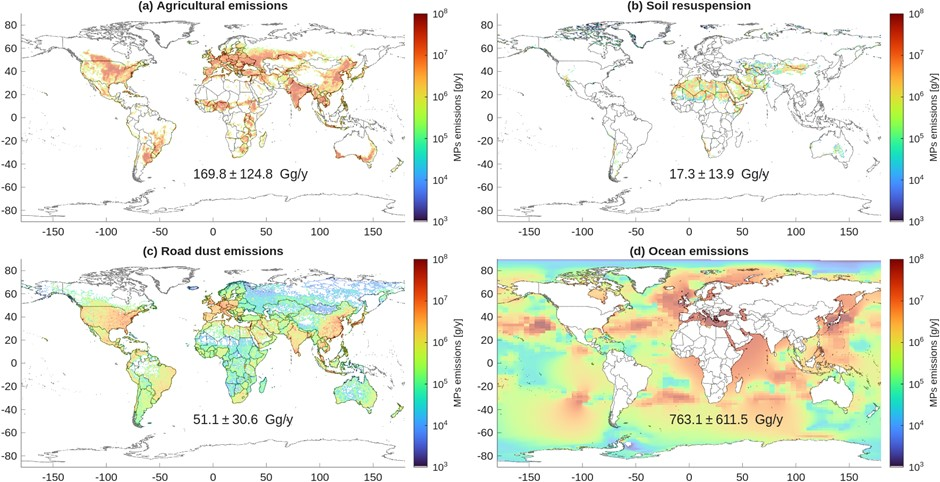
Microplastics emissions inferred using FLEXPARTv11 combined with Bayesian inversion.
Data policy
The data are available free of charge for non-commercial and scientific use. By using this data, you as data user accept that an offer of co-authorship will be made through personal contact with the data providers or owners whenever substantial use is made of their data. In all cases, an acknowledgement must be made to the data providers or owners and to the project name when these data are used within a publication. When used, the dataset should be cited using the Digital Object Identifier (DOI).
Download data
- https://secondary-data-archive.nilu.no/atmo-access/RANDOM/GibbsMPs/ - Ondřej Tichý (otichy@utia.cas.cz), Nikolaos Evangeliou (ne@nilu.no)
Method
EMISSIONS_MPS_720x360_GIBBS.nc: Atmospheric MP (AMP) emissions were calculated using observations from Brahney et al. (https://doi.org/10.1126/science.aaz5819) and the LS-APC (least squares with adaptive prior covariance) model (Tichý et al., https://doi.org/10.5194/gmd-9-4297-2016). We regularize the possible solutions using patterns from mineral and road dust, agriculture and sea spray. We link observations to emissions using source-receptor-sensitivities (SRS) calculated with FLEXPART version 11 (Bakels et al., https://doi.org/10.5194/gmd-17-7595-2024), a model suitable for AMPs that considers non-spherical shapes during gravitational settling of (Tatsii et al., https://doi.org/10.1021/acs.est.3c08209).
EMISSIONS_MPS_720x360_YANGcyl.nc: Yang et al. (2025) reported annual mass emissions per size fraction (< 70 μm). They assumed that the major MP sources would be continental emissions (10,000 Gg/y) with a relatively insignificant source from the ocean (0.8 Gg/y) and bare soil resuspension of 300 Gg/y. Then we split the continental sources equally into agricultural and road dust emissions (5,000 Gg/y each) and used the same patterns as those used in our posterior to distribute these masses in a global domain. To further convert from mass to number emissions, we assumed particles to be cylinders with aspect ratio of 20 and with same density as the one measured by Brahney et al. (https://doi.org/10.1126/science.aaz5819) (ρ = 1.22 g cm−3).
EMISSIONS_MPS_720x360_YANGsph.nc: Same as before, but the conversion of number to mass emissions was performed assuming spherical shape with diameter < 70 μm.
EMISSIONS_MPS_720x360_FU.nc: Emissions from Fu et al. (https://doi.org/10.1016/j.oneear.2023.05.012) were gridded, but they were rescaled to match our posterior emission resolution (0.5°×0.5°).
EMISSIONS_MPS_720x360_GIBBS_v2.nc: Same method as before (Tichý et al., https://doi.org/10.5194/gmd-9-4297-2016) compiling observations from Brahney et al. (https://doi.org/10.1126/science.aaz5819). Bug fixes and updated global emissions (1001 Gg y-1).
EMISSIONS_MPS_720x360_GIBBS_v3.nc: Following recent studies by Evangelou et al. (https://doi.org/10.1038/s41586-025-09998-6) and Yang et al. (https://doi.org/10.1038/s41612-025-00914-3) that ocean contributes negligibly in the AMP budget, we have scaled oceanic emissions in version 2 (EMISSIONS_MPS_720x360_GIBBS_v2.nc) by a factor of 10 lower and road dust emissions by a factor of 10 higher resulting in 76.3 Gg y-1 of oceanic emissions, 511 Gg y-1 of road dust, 170 Gg y-1 of bare soils and 17 Gg y-1 of agricultural ones and a total annual sum of 774 Gg y-1.
Acknowledgements
This research has been supported by the Czech Science Foundation (grant no. GA24-10400S) and MAGIC (RCN grant no. 334086). The computations/simulations were performed on resources provided by Sigma2 - the National Infrastructure for High Performance Computing and Data Storage in Norway.
Citation
Tichý, O., Evangeliou, N.: Microplastics emissions inferred using FLEXPARTv11 combined with Bayesian inversion, https://doi.org/10.82160/c8h5-rm98